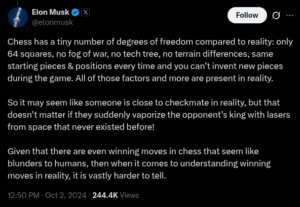
Actually, chess has a tech tree

A few years ago, Elon posted (it’s a real tweet; just screenshotting for posterity) that Chess doesn’t have a “tech tree”:

see full tweet at https://x.com/elonmusk/status/1841521084559945980?lang=en

I disagree. First, there’s promotion of pawns. Then, there is castling, which moves the king from a center file to relative safety on the side, at the same time moving a rook into the center and a more active role. And of course we speak of developing one’s knights (who could be likened to indirect fire), bishops (who provide enfillade fire), and rooks by moving them from their starting position into ones where they can more actively attack and defend. the middle of the board. There are even various systems for scoring board position based on piece development. If this isn’t a tech tree, I don’t know what is.

Cajal on “diseases of the will”

Charles Reiss (h/t) recently recommended me a short book by Santiago Ramón y Cajal (1852-1934), an important Spanish neuroscientist and physician. Cajal first published the evocatively titled  Reglas y Consejos sobre Investigación Cientifica: Los tónicos de la voluntad in 1897 and it was subsequently revised and translated various times since then. By far the most entertaining portion for me is chapter 5, entitled “Diseases of the Will”. Despite the name, what Cajal actually presents is a taxonomy of scientists who do contribute little to scientific inquiry:  “contemplators”, “bibliophiles and polyglots”, “megalomaniacs”, “instrument addicts”, “misfits”, and “theorists”. I include a PDF of this brief chapter, translated into English, here for interested readers, under my belief it is in the public domain.

Email discipline

There is a Discourse on what we might call email discipline. Here are a few related takes.

There are those who simply don’t respond to email at all. These people are demons and you should pay them no mind. 

Relatedly, there are those who “perform” some kind of message about their non-email responding. Maybe they have a long FAQ on their personal website about how exactly they do or do not want to be emailed. I am not sure I actually believe these people get qualitatively more email than I do. Maybe they get twice as much as me, but I don’t think anybody’s reading that FAQ buddy. Be serious.

There are those who believe it is a violation to email people off-hours, or on weekends or holidays, or whatever. I don’t agree: it’s an asynchronous communication mechanism, so that’s sort of the whole point. I can have personal rules about when I read email and these depend in no way on my rules (or lack thereof) about when you send them. Expecting people to know and abide by your Email Reading Rules FAQ is just as silly.

I have an executive function deficit, diagnosed as a child (you know the one), and if you’re lucky, they teach you strategies to cope. I think non-impaired people should just model one of the best: email can’t be allowed to linger. If it’s unimportant, you need to archive it. If it’s important you need to respond to it. You should not have a mass of unopened, unarchived emails at any point in your life. It’s really that easy.

Snacks at talks

The following is how to put out a classy spread for your next talk; ignoring beverages and extras, everything listed should ring up at around $50.

  • The most important snack is cheese. Yes, some people are vegan or lactose-intolerant, but cheese is one of the most universally-beloved snacks world-wide. Most cheeses keep for a while with refrigeration, and some even keep at room temperature. Cheese is, as a dear friend says, one of the few products whose quality scales more or less linearly with its price, and I would recommend at least two mid-grade cheeses. I usually buy one soft one (Camembert, Brie, and Stilton are good choices) and one semi-hard one (Emmental or an aged Cheddar for example). The cheese should be laid out on a cutting board with some kind of metal knife for each. The cheese should not be pre-cut (that’s a little tacky). Cheeses should be paired with a box of Carr’s Water Crackers or similar. Estimated price: $15-20.
  • Fresh finger vegetables are also universally liked. The easiest options are finger carrots and pre-cut celery sticks. If you can find pre-cut multi-color bell peppers or broccoli, those are good options too. You can pair this with some kind of creamy dip (it’s easy to make ranch or onion dip using a pint of sour cream and a dip packet, but you need a spoon or spatula to stir it up) but you certainly don’t have to. Estimated price: $10-20.
  • Fruit is a great option. The simplest thing to do is to just buy berries, but this is not foolproof: blueberries are a little small for eating by hand; raspberries lack structural integrity, and where I live, strawberries are only in season in the mid-summer, and are expensive and low-quality otherwise. In Mid-Atlantic cities, there are often street vendors who sell containers of freshly-cut fruit (this usually includes slices of pineapples and mangos and bananas, and perhaps some berries) and if this is available this is a good idea too. Estimated price: $10-15.

This, plus some water, is basically all you need to put out. Here are some ways to potentially extend it.

  • Chips are a good option. I think ordinary salty potato chips are probably the best choice simply because they’re usually eaten by themselves. In contrast, if you put out tortilla chips, you need to pair them with some kind of salsa or dip, and you need to buy a brand with sufficient “structural integrity” to actually pick up the dip.
  • Nuts are good too, obviously; maybe pick out a medley.
  • Soda water is really popular and cheap. I recommend 12oz cans. It should always be served chilled.
  • A few bottles or cans of beer may go over well. With rare exceptions, should be served chilled.
  • A bottle of wine may be appropriate. Chill it if it’s a varietal that needs to be chilled.

If the talk is before noon, coffee (and possibly hot water and tea bags) is more or less expected. There is something of a taboo in the States of consuming or serving alcohol before 4pm or so, and you may or may not want your event to have a happy hour atmosphere even if it’s in the evening.

And here are a few things I cannot recommend:

  • In my milieu it is uncommon for people to drink actual soda.
  • I wouldn’t recommend cured meats or charcuterie for a talk. The majority of people won’t touch the stuff these days, and it’s pretty expensive.
  • I love hummus, but mass-produced hummus is almost universally terrible. Make it at home (it’s easy if you have a food processor) or forget about it.
  • Store-bought guacamole tastes even worse, and it has a very short shelf life.

Introducing speakers

The following are my (admittedly normative) notes on how to introduce a linguistics speaker.

  • The genre most similar to the introduction of speaker is the congratulatory toast. An introduction should be brief, and the lengthy written introduction should be scorned. The speaker is already making an imposition on the audiences’ time, and for the host to usurp more of this time than necessary is a further imposition on both host and audience.
  • The introduction is not an opportunity for the introducer to demonstrate  erudition, but it can be an opportunity to show wit.
  • The introduction should be in the introducer’s voice. For this reason, a biography paragraph provided by the speaker should not be read as part of the introduction.
  • The introduction should be extemporaneous. The introducer can prepare brief notes, but they should fit on a notecard or their hand, and the notes should never be “read”.
  • Polite humor, brief personal anecdotes (e.g., when the introducer first met the speaker or became aware of their work), and heart-felt superlatives or compliments (one of the nicest introductions I ever received stated that I was “in the business of keeping people honest”) are to be encouraged.
  • The introduction should state the speakers’ current affiliation and title, if any, but need not list their full occupational or educational history unless it is judged relevant.
  • Introducers may feel an urge to read the title of the talk when concluding their introduction, but should resist this urge. There is no real need—the audience already has seen the talk title in the program or other announcements, and they can read the slide—and the speaker normally feels the need to read it out loud regardless.
  • The introduction should conclude with the speaker’s name. In one common style, which I consider elegant, the introducer is careful not to say the speaker’s full name until this conclusion, and uses epithets like “our next speaker” or “our honored guest” earlier in the introduction.

Professional organizations in linguistics

I am a member of the Linguistic Society of America (LSA) and the Association for Computational Linguistics (ACL), US-based professional organizations for linguists and computational linguists, respectively. (More precisely, I am usually a member. I think my memberships both lapsed during the pandemic and I renewed once I started going to their respective conferences again.)

I attend LSA meetings when they’re conveniently located (next year’s in Philly and we’re doing a workshop on Logical Phonology), and roughly one ACL-hosted meeting a year as well. As a (relatively) senior scholar I don’t find the former that useful (the scholarship is hit-or-miss and the LSA is dominated by a pandemonium of anti-generativists who are best just ignored), but the networking can be good. The *CL meetings tend to have more relevant science (or at least they did before prompt engineering…) but they’re expensive and rarely held in the ACELA corridor.

While the LSA and the ACL are called professional organizations, their real purview is mostly to host conferences. The LSA does some other stuff of course: they run Language, the institutes, and occasionally engage in lobbying, etc. But they do not have much to say about the lives of workers in these fields. The LSA doesn’t tell you about the benefits of unionizing your workplace. The ACL doesn’t give you ethics tips about what to do if your boss wants you to spy on protestors.  They don’t really help you get jobs in these fields either. They could; they just don’t.

There is an interesting contrast here with another professional organization I was once a member of: the Institute of Electrical and Electronics Engineers (IEEE, pronounced “aye Tripoli”). Obviously, I am not an electrical engineer, but electrical engineering was historically the home of speech technology research and their ASRU and SLT conferences are quite good in that subfield. During the year or so I was an IEEE member, I received their monthly magazine. Roughly half of it is in fact just stories of general interest to electrical engineers; one that stuck with me argued that the laws of physics preclude the existence of “directed energy weapons” claimed to cause Havana Syndrome. But the other half were specifically about the professional life of electrical engineers, including stuff about interviewing, the labor market outlook, and working conditions.

Imagine if Language had a quarterly professional column or if the ACL Anthology had a blog-post series…

Hiring season

It’s hiring season and your dean has approved your linguistics department for a new tenure line. Naturally, you’re looking to hire an exciting young “hyphenate” type who can, among other things, strengthen your computational linguistics offerings, help students transition into industry roles and perhaps even incorporate generative AI into more mundane parts of your curriculum (sigh). There are two problems I see with this. First, most people applying for these positions don’t actually have relevant industry experience, so while they can certainly teach your students to code, they don’t know much about industry practices. Secondly, an awful lot of them would probably prefer to be a full-time software engineer, all things considered, and are going to take leave—if not quit outright—if the opportunity ever becomes available. (“Many such cases.”) The only way to avoid this scenario, as I see it, is to find people who have already been software engineers and don’t want to be them anymore, and fortunately, there are several of us.

The dark triad professoriate

[I once again need to state that I am not responding any person or recent event. But remember the Law of the Subtweet: if you see yourself in some negative description but are not explicitly named, you can just keep that to yourself.]

There is a long debate about the effects of birth order on stable personality traits. A recent article in PNAS1 claims the effects are near null once proper controls are in place; the commentary it’s paired with suggests the whole thing is a zombie theory. Anyways, one of the claims I remember hearing was that older siblings were more likely to exhibit subclinical “Dark Triad” (DT) traits: Machiavellianism, narcissism, and psychopathy. Alas, this probably isn’t true, but it is easy to tell a story about why this might be adaptive. Time for some game theory. In a zero-sum scenario, if you’re the most mature (and biggest) of your siblings, you probably have more to gain from non-cooperative behaviors, and DT traits ought to select for said behaviors. A concrete (if contrived example): you can either hog or share the toy, and the eldest is by more likely to get away with hogging.

I wonder whether the scarcity of faculty positions—even if overstated (and it is)—might also be adaptive for dark triad traits. I know plenty of evil Boomer professors, but not many that are actually DT, and if I had to guess, these traits (particularly the narcissism) are much more common in younger (Gen X and Millennial) cohorts. Then again, this could be age-grading, since anti-social behaviors peak in adolescence and decline afterwards.

Endnotes

  1. This is actually a “direct submission”, not one of those mostly-phony “Prearranged Editor” pieces. So it might be legit.

Our vocation

If you’re a linguist: well, why?

One thing that stands out about the life of the professional linguist is what Chomsky has the responsibility of intellectuals, to “speak to the truth and to expose lies”, in this case uncomfortable truths about language and its role in society. Certainly this responsibility—and privilege, as Chomsky also points out—is inspiration for many linguists. But other motives abound. I for one am more drawn to learning about (an admittedly narrow corner) of human nature than I am to speaking truth to power, and most likely would have ended in some other area of social science had I not discovered the field. And there’s nothing wrong with a linguist who is most of all drawn to little logic puzzles, so long as these puzzles are ultimately grounded in those questions about human nature. (I do reject, categorically, those who say that linguists ought to be doing nothing than “Word Sudoku” or “Wordle with more steps”. Maybe there are people who work solely in those modes, and if so I wish them a very happy alt-ac career transition.)

I think the truths about human nature uncovered by the epistemology-obsessed generativists—including those of the armchair variety—has something to say about the proper organization of society. But one is more likely to get such messages from sociolinguists. Sociolinguists correctly point out that we have unexamined, corrosive ideologies about language, languages, and their speakers that are mostly contrary to the liberal values most of us profess, and they certainly are well-positioned to speak these truths. That said, I do not agree with an often-implicit assumption that sociolinguistics is somehow a more noble vocation than other topics in the field. The “discourse” on this is often fought as a proxy war over hiring: e.g., one I’ve heard before is “Why doesn’t MIT’s linguistics faculty include a sociolinguist?” First off, it sort of does: it includes one of the world’s foremost creolists, who has written extensively about the role of creole studies in neocolonialism and white supremacy. Whether or not a creolist is a sociolinguist is probably more a matter of self-identity than one of observable fact, but there’s no question that creole studies has a lot to give to—but also a both a lot to answer for on—the problem of linguistic equality. Should the well-rounded linguist have studied sociolinguistics? Absolutely. But there are probably many other areas, topics, or even theories you think that any well-rounded linguist ought to have studied but which are not required or widely taught, and these rarely provoke such discourse.

Generativism and anti-linguistics

I strongly identify with the generativist program. I recognize and accept that there are other ways to study language; some of these (e.g., any reasonably careful documentary work) contribute to generativist discourse and many of those that don’t are still prosocial. I for one would love to see the humanist aspect of documentation get more recognition. (Why don’t humanities programs hire linguists engaged in documentation and translation efforts?) But I’m most interested in the scientific aspects of language and think that generativism basically encompasses the big questions in this area, and some of the questions it doesn’t encompass just aren’t very important.

I don’t think it’s really ideal to brand generativism as Chomskyanism, which is the term anti-generativists tend to use. Certainly Chomsky is the plurality contributor to the program, but I think it gives undue credit to a single individual when there are so many others worth recognizing. I suspect the reason anti-generativists prefer it is they tend to see generativism as a cult of personality and perhaps want to trade on the repute of Chomsky’s (admittedly, extremely idiosyncratic but conceptually unrelated) political commitments. In evolutionary biology, it is common to refer to the modern theory of natural as the neo-Darwinian synthesis or modern synthesis. This makes sense because in 2024 there are no “strict Darwinists”, since subsequent work has integrated his monumental contributions with Mendelian and molecular genetics. Similarly, linguistics has no “strict Chomskyans”, even though we linguists eagerly awake our Mendel and our Crick & Watson.

The thing that sticks with me about the anti-generativist contingent is how disunited and disorganized they are. Anti-generativists are mostly a sincere lot (generativists too), but their attitudes are greatly shaped by negative polarization and as such, they have strange bedfellows. On the anti-generativist internet, you’ll see Adorno-disciple social constructivists talking at cross-purposes with construction grammarians, self-identified leftist/radical sociolinguists palling around with neocon consent-manufacturing journalists, experimental psycholinguists who reserve all their respect for exactly one out-of-practice fieldworker, tensorbros who don’t read books, and a few really mad, really old Boomers who never managed to build a movement around their heresy. By all accounts these people ought to hate each other. (And maybe, deep down, they do.)

In the worst case these conservations tend to veer away from constructive critique to a kind of anti-linguistics which devalues any form of language analysis that isn’t legible either as social activism or white-coat-wearing lab science. I for one can’t take your opinion about the science of language seriously if you can’t do the “armchair linguistics” that forms the descriptive-empirical base of the field. There are anti-generativists who clear this low bar, but not many. You don’t have to be a genius to do linguistics, but you do sort of have to be a linguist.

In my opinion, generativism has never been hegemonic beyond the level of individual departments, and claims otherwise are simply scurrilous. (Even MIT is a hotbed of anti-generativist reaction, after all.) But I think it would be a shame for college students to get a liberal arts education without learning about these very interesting ideas about human nature (in addition to standard consciousness-raising about prescriptivism and language ideology, which is important too).